
How to Make Beef Jerky in a Smoker: Cure, Slice, and Dry
As an Amazon Associate, MeatLogic earns from qualifying purchases.
Jerky is the cheapest thing you can make on a smoker and the easiest to get slightly wrong. Not dangerously wrong, usually, just disappointing: too tough to chew, or so dry it shatters, or fine on day one and questionable by the end of the week.
Three decisions do almost all the work. The cut you buy, the direction you slice it, and whether you cure it.

Buy a lean cut, and mean it
Fat does not dry. It goes rancid. Every bit of fat left on a strip is a countdown timer on how long the batch keeps, which is why jerky is the one place in barbecue where marbling is the enemy.
The standard choice is eye of round: lean, cheap, uniform, and shaped like a log that slices into neat rectangles. Top round and bottom round work the same way. Flank and skirt make good jerky with a more aggressive grain and cost more.
Trim every scrap of visible fat and silverskin before slicing. Be ruthless. What looks like a trivial seam of fat on a raw strip is a soft, greasy patch in the finished piece.
Slice direction decides the texture
This is the part people get wrong, and it is not a subtle difference.
- With the grain gives you chewy, stringy jerky that you tear at. This is traditional and what most commercial jerky does.
- Against the grain gives you jerky that breaks cleanly when you bite it, closer to a crisp snap than a chew.
Neither is wrong. Decide which you want before the knife comes out, because you cannot change your mind afterwards.
Aim for about a quarter inch thick, and be consistent about it more than precise. A batch of even 5 mm strips dries predictably. A batch that ranges from 3 mm to 10 mm has some pieces like shoe leather while others are still damp.
Freeze the meat for an hour first. Firm, partly frozen beef slices far more evenly by hand than floppy cold beef. If you make jerky regularly, a meat slicer removes the variable entirely.
The cure question
Here is where jerky differs from everything else you smoke.
Jerky spends hours in a temperature range that is ideal for bacterial growth, then gets stored at room temperature for weeks. That combination, low heat for a long time followed by unrefrigerated storage, is exactly the situation curing salt exists for.
Prague Powder #1 is 6.25 percent sodium nitrite mixed into ordinary salt, dyed pink so you cannot confuse it with table salt. It protects against Clostridium botulinum, which ordinary salt does not touch, and it is what gives cured jerky its colour and tang.
The dose is 2.5 grams per kilogram of meat, which works out to about 156 ppm nitrite, safely under the 200 ppm ceiling. Our brine and cure calculator works this out for any batch weight and refuses to output a dose above that ceiling.
Three rules, none of them negotiable:
- Weigh it on a scale that reads to 0.1 g. Never a teaspoon, never by eye. Curing salt is toxic in excess and the margin between the correct dose and a harmful one is not large.
- It is not interchangeable with table salt in either direction. Table salt does not cure. Curing salt used as seasoning is dangerous.
- Keep it labelled and away from the regular salt. The pink dye exists precisely because people have made this mistake.
Can you skip the cure? Yes, if you are honest about what you are getting: an uncured, refrigerated product to eat within a week, not a shelf-stable snack. Plenty of people make jerky this way. Just do not make it this way and then keep it in a jar on the counter for a month.
Marinade, then patience
A basic marinade is soy sauce, Worcestershire, black pepper, garlic powder, and onion powder. Everything after that is preference: brown sugar for sweetness and a better bite, chilli for heat, liquid smoke if you want more smoke flavour than your smoker will give at low temperature.
Marinate for 6 to 24 hours in the fridge. Past 24 hours the texture starts to suffer and the salt penetration stops being an improvement.
Pat the strips completely dry before they go on. Surface moisture has to evaporate before drying begins, so wet strips simply waste the first hour and steam rather than dry.
Smoker temperature and time
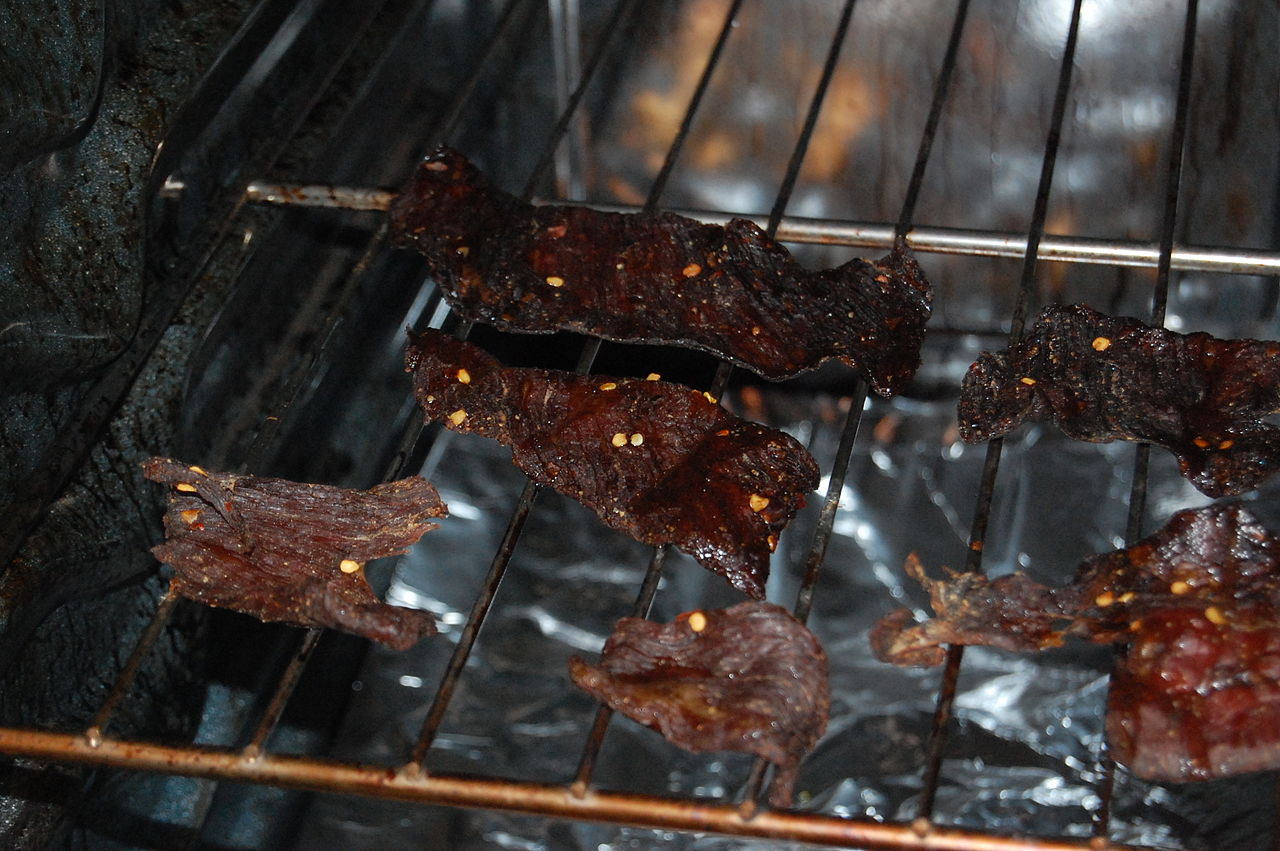
Jerky is dried, not cooked. You want the lowest stable temperature your smoker will hold, typically 160°F to 180°F, with good airflow. Leave a vent open. Trapped humid air is the enemy of the whole process.
Expect 4 to 6 hours at that temperature for quarter-inch strips. The range is wide because it depends on thickness, airflow, humidity, and how loaded the racks are. Start checking at three hours.
Use a mild wood. Hickory and mesquite overwhelm at these long exposures; apple, cherry, and oak are more forgiving. This is a rare case where less smoke is better, because four hours of heavy smoke on a thin strip is acrid rather than flavourful.
The safety step most guides skip
Drying at 160°F does not reliably pasteurise the meat. USDA FSIS guidance for home-made jerky is to bring the strips to 160°F internal before or after drying, and many smokers never actually get the interior of a strip to that temperature during a low-and-slow dry.
The fix is simple: when the jerky is done drying, put it in a 275°F oven for 10 minutes. That handles the lethality step without meaningfully changing the texture. Our meat temperature chart lists the USDA safe minimums for every cut, jerky included.
If you cured the meat and you post-heat it, you have a genuinely shelf-stable product. Skip either step and you have a refrigerated one.
How to tell when it is done
Do not go by the clock or by how it looks on the rack. Jerky firms up considerably as it cools, so anything that feels right while hot will be overdone once cool.
Take a strip off, let it cool for five minutes, then bend it. It should crack and show white fibres without snapping in half. If it breaks cleanly, it is overdried. If it folds without cracking, it needs longer.
Storage
- Cool completely first. Bagging warm jerky traps steam and undoes the drying.
- Cured and post-heated, in an airtight container: a couple of weeks at room temperature, months in the fridge.
- Uncured: refrigerate and eat within a week.
- A vacuum sealer roughly doubles the useful window.
- Check the jar after a day or two. Condensation means it was not fully dry, so put it back on for another hour.
What you actually need
A scale that reads to 0.1 g. Not optional if you are curing. A digital gram scale costs very little and is the difference between a measured dose and a guess.
Prague Powder #1. One bag of curing salt lasts years, because the dose is tiny.
Racks with airflow. Jerky sitting flat on a solid surface dries on one side. Most smokers come with adequate grates; a set of cooling racks gives you more capacity.
The short version
Buy eye of round. Trim all fat. Freeze an hour, slice a quarter inch, with the grain for chew or against for snap. Cure at 2.5 g/kg weighed on a proper scale. Marinate overnight, pat dry, smoke at 160°F to 180°F with a vent open for 4 to 6 hours, then 10 minutes in a 275°F oven. Cool, then bend-test.
Run your batch weight through the brine and cure calculator before you start, and check any temperature you are unsure of against the meat temperature chart.
Related
How Long to Smoke a Brisket at 225°F: The Real Answer
Roughly 60 to 90 minutes per pound, but the range matters more than the number. Here is how to plan a brisket cook that lands on time.
Sous Vide Steak Time and Temperature Guide for 2026
Thickness sets the time, temperature sets the doneness, and pasteurization is a third number most guides skip entirely.
Best Wireless Meat Thermometers in 2026
The one accessory that changes your barbecue more than a better smoker would, and the specification that actually decides which to buy.